Prank House Escape
- 4.0
- Rating
- 10.00M
- Installs
- Free
- Price

 Analysis by App-foxy
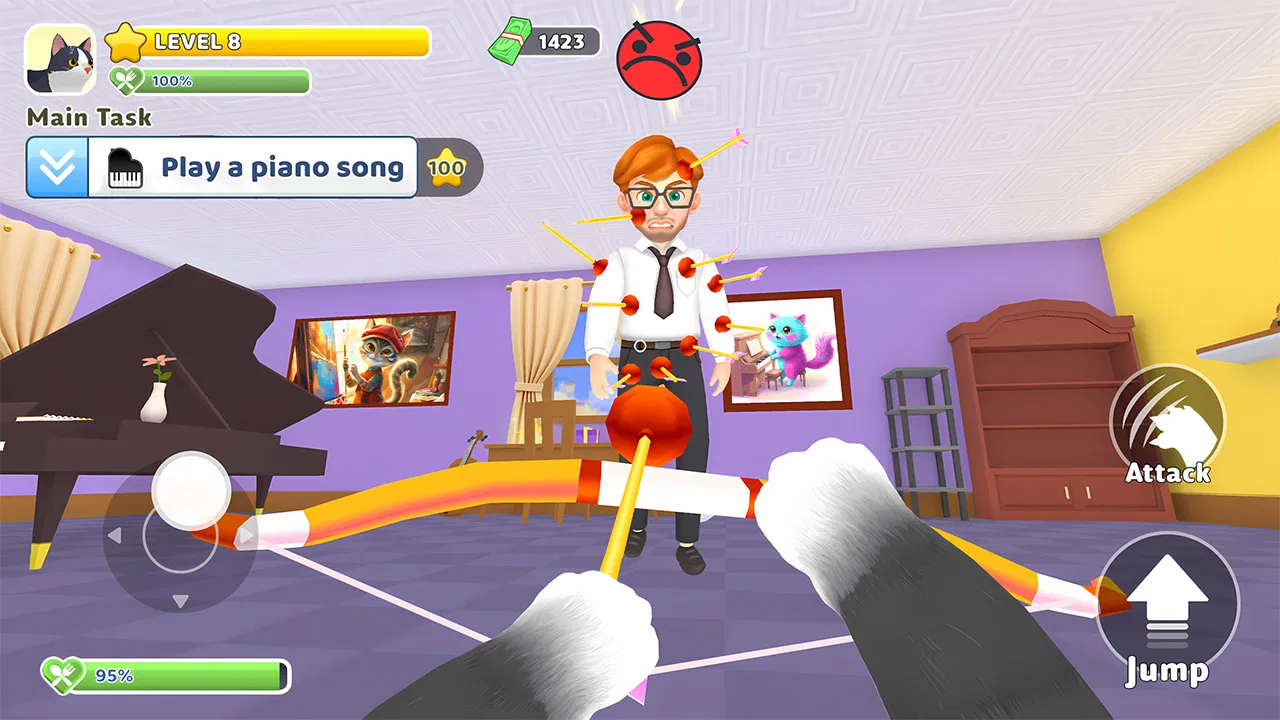
Prank House Escape is a lighthearted simulation game from Dinosaur House built around one clear idea: create trouble inside a house, then get away before anyone catches you. I found that focus more important than the short premise might suggest. Instead of asking me to manage a large city, build a complicated business, or survive a long campaign, it puts me in a small domestic space where every action is about timing, positioning, and the risk of being noticed.
That makes it easy to understand within a few moments, but not necessarily effortless to play well. The fun comes from turning an ordinary room into a little puzzle. I look at the surroundings, decide what kind of mischief is worth attempting, and then think about the safest way out. The game’s strongest capability is therefore not simply causing chaos; it is making escape part of the prank. Without that second step, the joke would feel like a one-button action. With it, even a simple setup can become a short challenge.
I would describe the game as a casual simulation experience rather than a serious stealth title. It is free, rated for Everyone, and available for players using Android 7.0 or later. Dinosaur House released it on April 29, 2025, and the current version is 1.0.41. Those details matter mainly because they position the game as something approachable for quick sessions, including for younger players who want playful mischief rather than frightening or complicated content.
You May Also Like

 Blood Strike: 2.5 Anniversary
Blood Strike’s Loadouts Turn Every Drop Into a Tactical Gamble
A close look at Blood Strike’s custom loadouts: how fast access to signature weapons reshapes its battle royale rhythm, rewards preparation, and narrows the gap between fights.

 Pandora - Music & Podcasts
Pandora’s Music Is Easy to Start, but Harder to Recover
Pandora’s strength is its low-effort path from a seed to a station. Its weak spot is how much confidence it asks you to place in connection, setup, and quiet recovery.

 8 Ball Pool
 Is Built on Rivalries, Rematches, and Routine
A close look at the rivalries, rematches, shared routines, and unanswered safety questions that turn a quick pool match into a persistent mobile community.

 Samsung Music
’s Quiet Strength Is Playing What You Already Own
Its reach comes less from spectacle than from dependable access to a personal library. That simplicity is both the app’s strongest retention engine and its ceiling.

 AccuWeather: Weather Radar
AccuWeather Review: A Quick, Clear Forecast for Everyday Decisions
For everyday plans, the best forecast is the one you can understand quickly. AccuWeather makes rain timing, radar, and local conditions easy to act on, with a few trade-offs.

 Hill Climb Racing
Why Hill Climb Racing Still Turns Crashes Into One More Run
A tiny car, a bumpy hill and one more upgrade: Hill Climb Racing keeps resurfacing because its simple chaos makes every near-miss feel personal.
More From Our News Desk



Why the escape changes the whole prank
Many prank-themed games would be satisfied with letting the player press an object, trigger a reaction, and move on. Prank House Escape gives that idea a more useful consequence: I have to think about what happens immediately afterward. The prank is only successful from my point of view if I can avoid being caught. That turns the house into more than a backdrop. It becomes the space I read before making a move and the route I depend on once the situation changes.
I noticed that this changes how I play even when the action itself is straightforward. I do not rush toward the first opportunity just because it is available. I pay attention to nearby space, possible exits, and whether my chosen moment is worth the risk. The best decisions are often small ones: waiting briefly, approaching from a better angle, or choosing a less dramatic action because it leaves me a cleaner escape.
This is also why the game works better as a short-session title than as a deep simulation. It does not need a long explanation to communicate its central loop. I enter a house, look for a chance to cause trouble, react to the consequences, and try to leave without being discovered. That loop is readable enough for a new player, while still giving experienced players a reason to improve their timing.
Reading the room before making a move
The most useful habit I developed was treating each room as a sequence rather than a collection of isolated objects. I first consider where I am, what could draw attention, and how much space I will have afterward. Then I commit to the prank. This sounds obvious, but it prevents the common mistake of starting an action without thinking about the return path.
For example, if I am playing during a short break, I do not try to force the most chaotic option immediately. I choose an action that I can understand quickly, observe what changes, and use the result to plan the next attempt. That approach makes the game feel less random and gives each failure a practical lesson. I can usually identify whether I acted too early, moved too far into danger, or simply ignored the safest route.
A second useful technique is to separate observation from movement. I spend a moment studying the available space before touching anything. This reduces careless mistakes and makes the escape feel earned rather than accidental. In a game centered on being caught, the pause before the prank is almost as important as the prank itself.
Turning failure into a better route
Failure is most enjoyable here when I can explain it. If I get caught because I acted without an exit in mind, the next attempt has a clear purpose. I can change my approach instead of repeating the same action and hoping the result improves. That makes the game surprisingly suitable for players who enjoy small, repeatable challenges but do not want a demanding strategy game.
I also found that a failed attempt can reveal how conservative I should be. Sometimes the tempting option is not the smart option. A smaller disturbance may be easier to control, while a more ambitious prank creates a better payoff only if I already understand the room. The trade-off is simple but effective: greater chaos can mean greater exposure.
That is one of the game’s non-obvious strengths. It encourages me to think in terms of risk management without presenting itself as a formal strategy title. I am not managing resources or constructing a detailed plan across a huge map. I am making quick judgments about risk, distance, and timing in a confined setting.
A realistic everyday way to play
The best scenario for Prank House Escape is a short break when I want something interactive but do not want to commit to a long story or a complicated system. I can play a few attempts, stop after a successful escape, and return later without needing to remember a large amount of information. That makes it a practical choice for a commute, a waiting room, or a few minutes before bed, provided the player is comfortable with repeating compact challenges.
Imagine having only a small amount of time before meeting a friend. I would open the game, choose a quick attempt, and focus on one goal: make a controlled disturbance and leave cleanly. If I fail, I can immediately identify what went wrong and try again. If I succeed, the session still feels complete rather than unfinished. This is where the escape-focused design earns its place; it gives a short play session a beginning, a decision point, and a clear result.
The game can also work as a casual shared experience. A younger player may enjoy the mischievous theme, while an older player can help with the more careful part: noticing the route out and choosing the right moment. Because the content rating is Everyone, the concept is easier to introduce in a family setting than a darker stealth or horror game. I would still recommend that adults judge whether the prank theme suits the individual child, but the basic presentation is clearly aimed at broad accessibility.
Who will enjoy the central loop
I think the strongest audience is made up of players who like playful stealth, quick reactions, and simple environmental puzzles. You do not need to enjoy realistic simulation games to understand the appeal. The house provides a familiar setting, and the objective is immediately readable. If you like experimenting, watching a situation become more chaotic, and then trying to recover, the format has a natural charm.
It is also a good fit for people who prefer low-pressure games with a mischievous tone. The objective is not to build the perfect empire or defeat a difficult opponent. It is to make a decision, see the result, and improve your next attempt. That makes the game approachable for someone who normally avoids complex management systems.
On the other hand, I would not choose it for a player looking for a substantial story, deep character development, or a long-term simulation. The appeal is concentrated in the prank-and-escape loop. If that loop does not sound enjoyable on its own, the surrounding presentation is unlikely to change your mind. Players who want a broad sandbox with extensive customization may be happier with a more open-ended simulation alternative.
Where it differs from usual simulation alternatives
Traditional simulation games often ask me to maintain systems over time. I might manage money, build a space, care for characters, or balance several competing needs. Prank House Escape is much narrower. Its simulation flavor comes from reacting to a domestic situation, not from maintaining a large world. That narrower scope is both its identity and its main limitation.
Compared with a conventional stealth game, it also appears less interested in long patrol patterns, elaborate missions, or serious tension. The mood is playful. I am not infiltrating a heavily guarded facility or solving a dramatic mystery. I am trying to create a funny problem and avoid the consequences. That difference makes it more accessible, but it also means players expecting sophisticated stealth behavior should keep expectations realistic.
Compared with a physics-focused sandbox, the game’s value is less about building elaborate experiments and more about the sequence of action and escape. I do not approach it expecting unlimited creative construction. I approach it expecting a focused challenge in which the house and the risk of detection give purpose to the prank. In my view, that focus is preferable to a larger but less coherent collection of mechanics.
The practical takeaway is simple: choose this game when you want a compact mischief scenario, not when you want a full life simulator or a deep stealth campaign. Its identity is strongest when the player accepts the small scale and pays attention to the consequences of each move.
What the free price means for the decision
Because the game is free, it is easy to test without treating the download as a major commitment. That suits the design well. I can discover quickly whether the central loop is entertaining for me. The more important question is not whether the entry cost is high, but whether I enjoy repeating short attempts and refining my choices.
A free game still needs to earn space on a device, and this one does that best for players who value immediate play. If I want a title I can understand quickly and revisit in small bursts, the format makes sense. If I prefer a game that steadily expands into a complex system, the free price alone is not a reason to stay.
The broad reach of the game is reflected in its reception: it has an average rating of 4.4 from around 6,400 ratings and has passed 10 million installs. I see those figures as signs that the simple premise connects with a large casual audience, not as proof that every player will enjoy it. The game still depends heavily on whether its compact prank loop matches your taste.
Small techniques that make attempts more satisfying
My first practical tip is to plan the exit before starting the prank. This is more useful than simply moving quickly. When I already know where I want to go, I can judge whether an opportunity is safe enough. It also helps me notice when I am being lured into a tempting action that leaves me exposed.
My second tip is to vary the timing rather than repeating the same approach immediately. If an attempt fails, changing only the movement may not solve the problem. Waiting for a better moment can be more effective than taking the identical route with more speed. This turns the game into a small timing exercise instead of a reflex contest.
Third, I recommend treating modest successes as valuable. Players can easily focus on making the biggest possible mess, but the safer action may teach more about the room. Once I understand how to escape reliably, I can take larger risks with a clearer idea of what I am sacrificing. That progression comes from my own decisions, not from needing a complicated upgrade system.
Finally, I avoid playing on autopilot. The game’s central challenge becomes dull if I simply tap through every obvious opportunity. I get more from it when I set a small personal objective, such as escaping by a different route or completing an attempt without rushing. These self-imposed variations extend the usefulness of the basic loop without pretending that it is a large strategy game.
Where the friction appears
The same simplicity that makes the game welcoming can make it feel limited. Once I understand the basic rhythm, the experience depends on how much variety I can find in the available situations. Players who need constant novelty may feel that the concept becomes familiar quickly. This is not a flaw in the core idea, but it is an important trade-off.
There is also a difference between amusing chaos and meaningful challenge. If the consequences of being caught do not feel significant enough, the escape objective can lose some of its tension. I found the game most engaging when I treated each attempt as a small experiment and least engaging when I expected a deep stealth system. The right mindset matters here.
Another limitation is that the game’s appeal is strongly tied to its tone. The prank theme will be entertaining for some players and irritating to others. Someone looking for calm decoration, thoughtful management, or a serious simulation should probably choose a different category. The game is not trying to be a realistic household simulator, and judging it by that standard would miss its purpose.
Device compatibility is relatively broad because the game supports Android 7.0 and newer. Still, I would check the system requirement before installing on an older phone or tablet. The current version is 1.0.41, so keeping the app updated is the sensible way to receive the intended version of the experience.
My recommendation after spending time with it
Prank House Escape works because it gives a familiar setting one focused rule: causing trouble is only half the job, and avoiding capture completes the challenge. I appreciate that the game does not bury that idea under unnecessary complexity. It is quick to understand, easy to revisit, and playful enough for casual sessions.
I would recommend it to a friend who enjoys short simulation games with a mischievous twist, especially someone who likes experimenting with timing and routes. It is a particularly good fit for players who want something lighter than a traditional stealth game but more interactive than a simple tap-based prank. The Everyone rating and free price also make it an easy title to try in a family or casual setting.
I would steer a friend elsewhere if they wanted a long narrative, a detailed household-management system, or a broad sandbox with deep customization. This game’s strength is concentration, not scale. Its best moments come from reading a room, choosing a risk, and escaping cleanly; its weakest moments appear when that compact loop no longer feels fresh.
Overall, I see it as a focused casual game rather than a complete simulation world. The large install base and 4.4 average suggest that many players enjoy its accessible premise, but my recommendation rests on the actual design: the escape requirement gives the prank a purpose and makes each small decision more interesting. If that sounds like the kind of harmless chaos you want during a short break, Dinosaur House has made a game worth trying.
FAQs for Prank House Escape
01What is Prank House Escape about?
Prank House Escape is an engaging puzzle-adventure game where players must navigate through a series of humorous and challenging escape rooms. Each room is filled with clever pranks and puzzles that require creative thinking to solve. The objective is to outsmart the prankster and escape each room, making it a fun and thrilling experience for all ages.
02Is Prank House Escape suitable for all age groups?
Prank House Escape is designed to be family-friendly and suitable for players of all ages. The puzzles are crafted to be challenging yet accessible, providing entertainment for both younger players and adults. However, younger children may need some assistance with more complex puzzles, making it a great game for family collaboration.
03Are there any in-app purchases in Prank House Escape?
Yes, Prank House Escape offers in-app purchases that enhance the gaming experience. While the game is free to download and play, players can purchase hints or additional content to ease their progress through challenging levels. These purchases are optional and not required to enjoy the full game experience.
04Does Prank House Escape require an internet connection?
Prank House Escape can be played offline, allowing players to enjoy the game anytime and anywhere without an internet connection. However, some features, such as in-app purchases and updates, will require connectivity. Playing offline ensures a seamless experience without interruptions.
05How often are new levels or updates added to Prank House Escape?
The developers of Prank House Escape are committed to keeping the game fresh and exciting by regularly adding new levels and updates. These updates often include new challenges, improved features, and bug fixes to enhance gameplay. Players can expect frequent content additions to keep them engaged.
Pros
- Engaging puzzles keep players hooked.
- High-quality graphics enhance realism.
- Interactive storyline adds depth.
- User-friendly interface for easy navigation.
- Regular updates with new challenges.
Cons
- Ads can interrupt gameplay frequently.
- Some puzzles are too difficult.
- Requires internet for full features.
- Limited hints available for players.
- Graphics may lag on older devices.

Prank House Escape
Gallery